
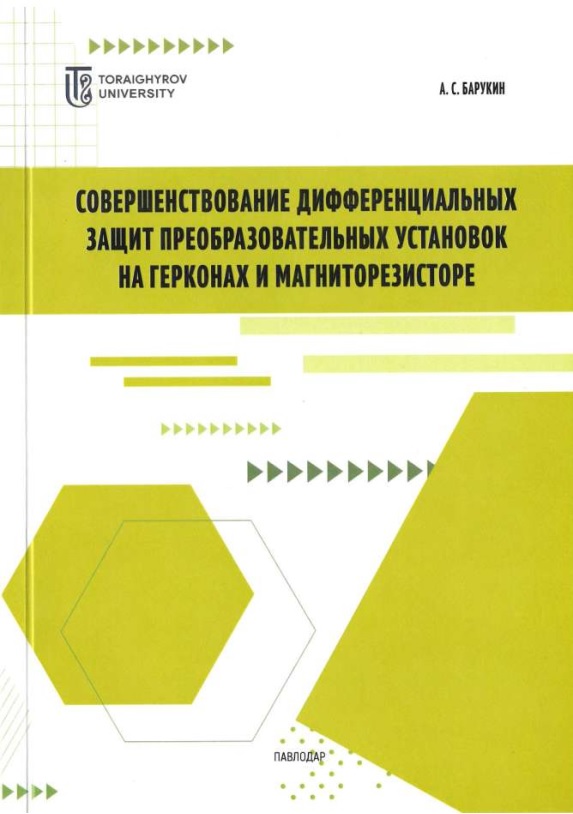
Monograph title: IMPROVEMENT OF DIFFERENTIAL PROTECTION OF CONVERTER INSTALLATIONS USING REED SWITCHES AND A MAGNETORESISTOR
Author: Alexsandr Sergeevich Barukin
ISBN 978-601-345-537-2
Brief Description: The monograph presents variants of constructing differential protections of converter installations (CIs) based on reed switches and magnetoresistors, characterized by increased sensitivity and high reliability of operation and non-operation. Methods for selecting their operating parameters are provided, and the applicable range of use is defined.
The first chapter examines traditional protections of converter installations, as well as newly developed protections implemented both on a traditional component base and on magnetically sensitive elements. The following points are noted:
1. The instantaneous overcurrent protection used as the main protection of CI transformers is simple, reliable, and inexpensive, but in some cases insufficiently sensitive because it must be restrained from load current. Differential protections may offer higher sensitivity, but their implementation is complicated, since the current transformers (CTs) installed on the high-voltage side of the CI transformer and on its DC side may have large size and weight. Furthermore, although CTs on the HV side of CIs are reliable, they are material-intensive, have unacceptable transient errors, and develop dangerous voltages across the open secondary circuit. Therefore, developing CI differential protections based on sensors free from these shortcomings is an urgent task.
2. One possible solution is the use of magnetically sensitive elements such as reed switches and magnetoresistors.
3. Differential protections built using these elements currently have insufficient sensitivity and reliability.
4. The issues of setting selection and determining the application area of such protections have not been given sufficient attention.
5. To apply the Biot–Savart–Laplace law in AC electrical installations, further research is required.
Known and recently proposed designs do not fully solve the problem of mounting reed switches and magnetoresistors near CI current-carrying elements.
The second chapter proposes a formula for calculating the magnetic field induction created by alternating currents flowing in the busbars of switchgear, in CI conductors, and in overhead transmission lines. The formula is based on the Biot–Savart–Laplace law and experimentally obtained correction factors. The methodology for determining these coefficients is described in detail, and a nomogram is provided for flat busbars of (60×6) mm² cross-section and tubular busbars of various diameters. Two developed differential protections of converter installations are examined; they exhibit higher sensitivity than existing analogues. The first protection, based on reed switches, achieves higher sensitivity by introducing blocking by the second harmonic. The second protection, based on a reed switch and a magnetoresistor with an automatically adjustable operating threshold, is improved by incorporating two setting-adjustment blocks based on RS-triggers into the known scheme and by adding ballast resistors into the Wheatstone bridge, their number equal to the number of tap changer positions. Methods for selecting settings and evaluating sensitivity of these protections are presented. It is shown that their application area is limited to converter installations with capacity from 0.25 to 10 MVA.
The third chapter states that the criterion for selecting the optimal version of relay protection devices (RPDs), taking into account their reliability, is the minimum of calculated reduced costs. It is noted that the main reliability indicators of RPDs are their unavailability coefficients for operation and non-operation, and that these coefficients should be determined using the logic-probabilistic method. It is established that the unavailability coefficients of the CI differential protection based on reed switches and a magnetoresistor are inferior to those of the most reliable traditional protections. Three redundancy schemes — duplicated, triplicated, and majority-based — are considered as possible ways of improving reliability of differential protection, and the reduction of reduced costs achieved by each scheme is analyzed. It is shown that the reduction is greatest under majority redundancy. Dependences of reduced costs under redundancy on the specific damage and the rated power of the protected installation are presented. A patented majority-based CI differential protection device with self-diagnostics is described, along with patented designs for mounting reed switches and magnetoresistors near CI conductors.
The monograph is intended for doctoral and master’s students in the field of “Electric Power Engineering” (specialization: relay protection) and may be useful to a wide range of professionals involved in designing relay protection devices.
Contents:
|
|
Introduction |
7 |
|
|
1 |
Relay protection of converter installations |
11 |
|
|
1.1 |
Traditional protections of converter installations |
11 |
|
|
1.2 |
Known new developments of converter installation protections implemented on a traditional component base |
15 |
|
|
1.3 |
Protections of converter installations based on magnetically sensitive elements |
20 |
|
|
1.3.1 |
Application of reed switches and magnetoresistors in relay protection |
20 |
|
|
1.3.2 |
Reed-switch-based protections |
23 |
|
|
1.3.3 |
Differential protection of converter installations using reed switches and a magnetoresistor |
27 |
|
|
|
Conclusions |
29 |
|
|
2 |
Enhancement of sensitivity and setting calculation of the considered differential protections of converter installations |
31 |
|
|
2.1 |
Feasibility of using the Biot–Savart–Laplace law for calculating magnetic fields in high-voltage ac electrical installations |
31 |
|
|
2.2 |
Enhancement of sensitivity and setting calculation of reed-switch-based differential protection |
38 |
|
|
2.3 |
Differential protection based on reed switches and a magnetoresistor with an automatically adjustable operating setting |
48 |
|
|
2.4 |
Setting selection and application area of differential protection based on reed switches and a magnetoresistor |
53 |
|
|
|
Conclusions |
62 |
|
|
3 |
Enhancing the reliability of differential protection of converter installations based on reed switches and a magnetoresistor |
63 |
|
|
3.1 |
Analysis of the effectiveness of using duplication, triplication, and majority redundancy to improve the reliability of converter installation protections |
63 |
|
|
3.2 |
Model of a majority-based differential protection device with self-diagnostics of faults |
68 |
|
|
3.3 |
Ensuring protection reliability through the development of simple structures for mounting reed switches and magnetoresistors |
72 |
|
|
3.3.1 |
Universal structure for mounting and adjusting the position of reed switches in compartmentalized busducts |
72 |
|
|
3.3.2 |
Strength assessment of the universal structure |
75 |
|
|
3.3.3 |
Model of a structure for mounting reed switches near ac conductors of converter installations |
78 |
|
|
3.3.4 |
Model of a structure for mounting reed switches or magnetoresistors near the busbars of enclosed DC busducts of converter installations |
79 |
|
|
|
Conclusions |
81 |
|
|
|
Conclusion |
83 |
|
|
|
References |
85 |
|
|
|
Appendix A |
Example of setting selection for differential protection based on reed switches and a magnetoresistor |
92 |
The full text of the monograph is available at the Beisembayev Library («Toraighyrov University» NJSC library), 64 Lomov Street, Pavlodar, Kazakhstan.
For purchase inquiries, please contact the Toraighyrov University Publishing House.
Contacts:
Phone: +7 (7182) 67-36-69 (ext. 1147)
E-mail: kereku@tou.edu.kz
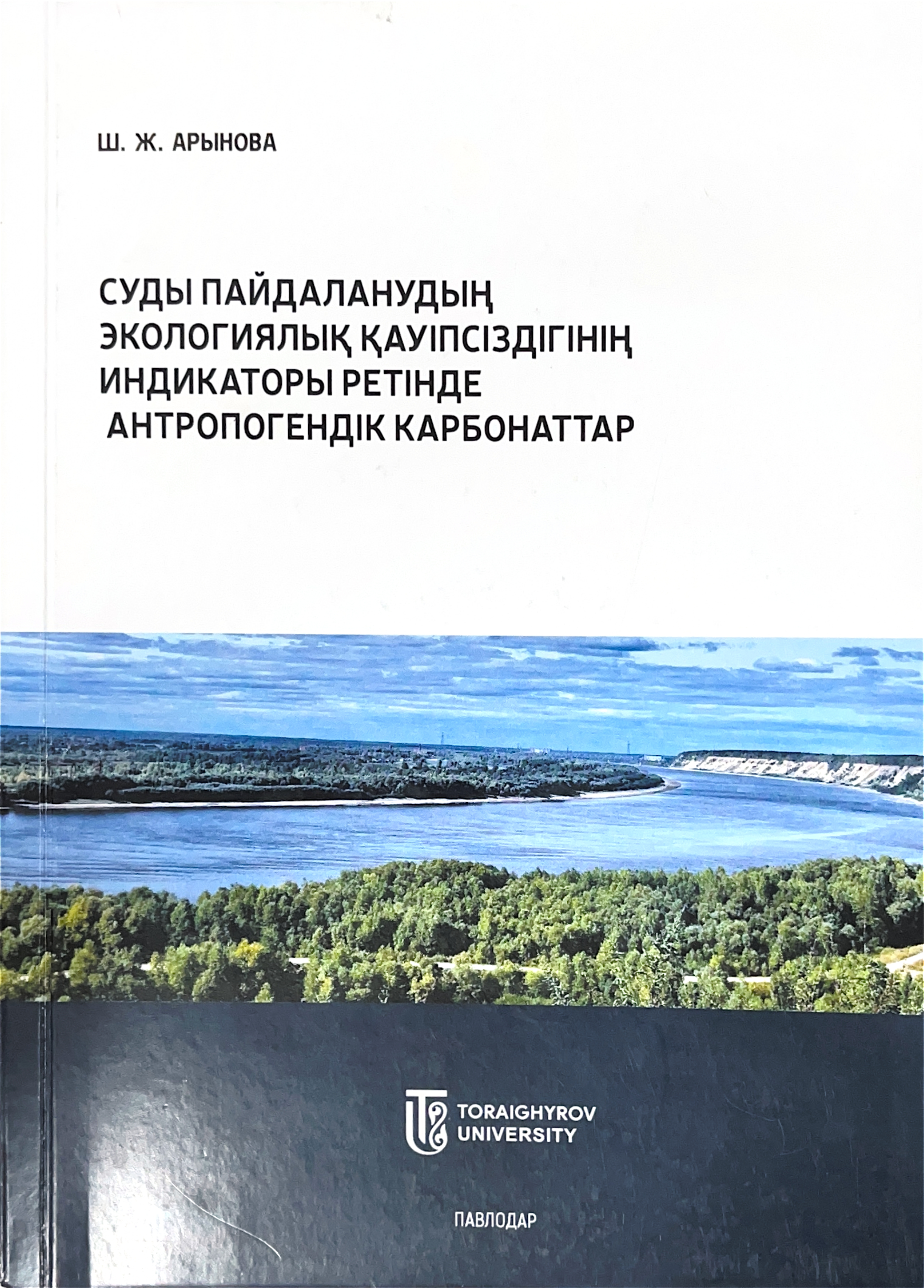
Monograph title: ANTHROPOGENIC CARBONATES AS AN INDICATOR OF ENVIRONMENTAL SAFETY OF WATER USE
Author: Arynova Shynar Zhanybekovna
ISBN 978-601-345-294-4
Brief Description: Water is one of the most important chemical compounds, widely distributed everywhere and playing a special role in all natural processes, including those occurring in living organisms. Since water is a carrier of many elements, the quality of its chemical composition causes certain concerns among the population. A person must always be confident in the environmental safety of the water resources being used. “Environmental safety of water use” refers to the set of interrelations between the population, ecosystems, the economy, and water bodies, ensuring compliance with a number of specific requirements. One of these requirements is the population’s access to water in the necessary quantity and of acceptable quality.
The chemical composition of water follows certain patterns determined by geological structure, tectonics, the geological history of the planet and individual geological formations, relief, climate, and the hydrological regime of regions.
The consumption of poor-quality drinking water leads to a deterioration in human health. As a result, the natural resistance of the body decreases, and early adverse functional changes in various physiological systems occur. When water is used for domestic and drinking purposes, it is often boiled repeatedly. During this process, complex electrochemical reactions and crystallization lead to the formation of scale due to a combination of factors. Primarily, this process is associated with the decomposition of calcium and magnesium bicarbonates when the water is heated, forming poorly soluble compounds - i.e., the solubility of such substances decreases as the temperature increases (calcium carbonate, magnesium carbonate, iron carbonate, magnesium hydroxide, magnesium oxide). If the carbonate hardness of the water exceeds a certain level, it tends to form scale.
Although numerous studies have been conducted on the development of methods for combating scale in industrial and household settings, as well as on the kinetics and mechanism of crystallization, there are also works addressing the use of this material in ecological-geochemical and prospective metallogenic research. According to previous studies, it is known that anthropogenic carbonates (scale) contain important geochemical information reflecting not only the specifics of landscape-geochemical and geological-metallogenic features of a territory, but also the relationship between population morbidity and the chemical elements contained in the scale. Anthropogenic carbonates as an object of study raise many questions—from the mechanisms of their formation to methodological approaches for interpreting the results obtained. Additional research is required regarding their use as an object for assessing water quality and its impact on human health, which determines the relevance of this monograph.
One of the important aspects when assessing the impact of environmental factors on human health is the qualitative characterization of environmental pollution.
The high pace of technogenesis, large-scale development, and increasing intensity of land use across extensive territories located in various geographical zones lead to profound alterations in engineering-hydrogeological conditions and in the geological environment as a whole. As a result, the water balance structure of territories is significantly modified under anthropogenic influence. The data obtained can be used to develop comprehensive environmental protection measures in areas with especially high concentrations of chemical elements in the bottom sediments of natural freshwater bodies.
This research confirms the prospects of using scale to assess the environmental safety of water sources and for medical-biological purposes, which in turn may serve as a foundation for creating a methodological framework for comprehensive environmental monitoring in Pavlodar Region.
The Pavlodar Regional Department of Environmental Protection and the Irtysh Ecology Division used the analytical data and element-distribution maps of scale from natural freshwater bodies as supplementary material for earlier studies of snow cover, hair, leaves, vegetable crops, and soils. This monograph represents an applied aspect of an effective environmental safety policy in water use. The research object chosen by the author - anthropogenic carbonates - is a promising indicator for determining the quality of water sources in environmental monitoring.
The monograph is of interest to university and college students studying environmental sciences, as well as to master’s and doctoral students.
Contents:
|
|
Introduction |
3 |
|
1 |
Scale formation during repeated boiling of water |
5 |
|
2 |
Brief physical-geographical, geological, hydrological, and environmental characteristics of Pavlodar region |
11 |
|
2.1 |
Landscape features |
14 |
|
2.2 |
Geological characteristics |
15 |
|
2.3 |
Hydrogeological study of the territory |
17 |
|
2.4 |
Geoecological condition of the territory |
22 |
|
3. |
Materials and methods of research |
27 |
|
3.1 |
Sampling procedure |
27 |
|
3.2 |
Experimental data |
29 |
|
3.3 |
Laboratory studies and sample analysis methods |
32 |
|
3.4 |
Data processing methodology |
37 |
|
4 |
Mineral composition of salt deposits in drinking water of pavlodar region |
39 |
|
5 |
Assessment of water quality based on uranium content in scale from settlements of Pavlodar region |
44 |
|
5.1 |
Relationship between scale composition and hydrogeochemical characteristics of water |
44 |
|
5.2 |
Uranium content in drinking water |
48 |
|
6 |
Elemental composition of anthropogenic carbonates in settlements of Pavlodar region |
58 |
|
6.1 |
General geochemical characteristics of anthropogenic carbonates |
58 |
|
6.2 |
Spatial distribution of chemical elements in anthropogenic carbonates |
68 |
|
6.3 |
Radioactive elements in anthropogenic carbonates |
78 |
|
6.4 |
Rare earth elements in anthropogenic carbonates |
81 |
|
7 |
Chemical element composition of anthropogenic carbonates within the city of Pavlodar |
87 |
|
8 |
Impact of chemical composition of salt deposits in natural freshwater on the health of the population of Pavlodar region |
97 |
|
8.1 |
Analysis of the relationship between the chemical composition of scale and morbidity among adult and child populations |
103 |
|
|
Conclusion |
113 |
|
|
References |
114 |
The full text of the monograph is available at the Beisembayev Library («Toraighyrov University» NJSC library), 64 Lomov Street, Pavlodar, Kazakhstan.
For purchase inquiries, please contact the Toraighyrov University Publishing House.
Contacts:
Phone: +7 (7182) 67-36-69 (ext. 1147)
E-mail: kereku@tou.edu.kz
 (1)_pages-to-jpg-0001.jpg)
Monograph title: THE ABERDEEN ANGUS BREED AND THE ADAPTATION AND PRODUCTIVITY OF THEIR GENERATIONS IN KAZAKHSTAN
Author: Titanov Zhanat Eginbaevich
ISBN 978-601-345-639-3
Brief Description: The monograph written by Zh.E. Titanov, titled “Aberdeen Angus Breed and the Adaptation and Productivity of Their Generations in Kazakhstan”, is devoted to the study of the adaptive, breeding, and productive traits of Aberdeen Angus cattle under the conditions of Kazakhstan. The work addresses relevant issues in the development of pedigree beef cattle breeding, the effective use of imported genetic resources, and their adaptation to the country’s natural-climatic and feeding conditions.
The relevance of the research is determined by the need for industrial development of beef cattle production in the Republic of Kazakhstan, as well as by the improvement of domestic breeding herds through the wide use of highly productive imported breeds, particularly Aberdeen Angus. Given the diversity of Kazakhstan’s natural and climatic zones, studying the degree of acclimatization and physiological adaptation of foreign breeds is an important prerequisite for improving herd productivity and resilience.
The first chapter of the monograph provides a detailed examination of the biological significance of adaptation as a fundamental property of living organisms. It reveals the mechanisms of animal responses to environmental factors and describes the adaptive capacities of beef cattle. The chapter also includes an analysis of the history of selective improvement of the Aberdeen Angus breed in Kazakhstan and abroad, as well as its genetic features.
The second chapter presents data on the distribution of the Aberdeen Angus breed in Kazakhstan, its share in the overall cattle population, and the breeding and class structure of herds. It describes the live weight of cows and breeding bulls, exterior traits, milk production, growth dynamics of young stock, and provides a comparative analysis of reproductive indicators and breeding qualities of the animals.
The third and fourth chapters define the scientific novelty and practical significance of the work. They present a comprehensive study of the physiological, ethological, and productive characteristics of second- and third-generation Aberdeen Angus cattle. The author thoroughly investigates feeding characteristics, physiological condition, behavioral reactions, milk performance, and the development of maternal instincts in second-generation heifers.
In third-generation animals, the research includes scientific analysis of growth and development, physiological maturity, tolerance to low and high temperatures, hematological and biochemical parameters, natural resistance, morphological characteristics of the coat, as well as quantitative and qualitative indicators of meat productivity.
The scientific novelty of the monograph lies in the fact that, for the first time, a systematic and comprehensive description is provided of the physiological and productive changes in the descendants of the Aberdeen Angus breed formed under the continental climatic conditions of Kazakhstan. The research identifies patterns of the adaptation process, the degree of preservation of genetic potential, and proposes specific biological and zootechnical indicators applicable in breeding and production practice.
The results obtained can be used to define directions for breeding work in beef cattle production, improve pedigree herds, and ensure the effective adaptation of imported breeds to local environmental conditions. The materials of the monograph are intended for faculty members, master’s and doctoral students, as well as researchers and practitioners working in the field of beef cattle breeding.
Contents:
|
|
Introduction |
3 |
|
1 |
Justification of the topic |
6 |
|
1.1 |
Adaptation as a fundamental property of living matter |
6 |
|
1.2 |
Acclimatization and adaptive capacity of beef cattle |
9 |
|
1.3 |
Development and improvement of the Aberdeen Angus breed in Kazakhstan and abroad |
12 |
|
1.4 |
Development of imported beef cattle under the conditions of Kazakhstan |
16 |
|
1.5 |
Biological characteristics of the Aberdeen Angus breed |
20 |
|
2 |
Breeding and productive qualities of Aberdeen Angus cattle in Kazakhstan |
31 |
|
2.1 |
Cattle population in the Republic of Kazakhstan, including the share of the Aberdeen Angus breed |
31 |
|
2.2 |
Breed and class structure |
35 |
|
2.3 |
Live weight of cows and breeding bulls |
37 |
|
2.4 |
Exterior traits of Aberdeen Angus cattle |
40 |
|
2.5 |
Milk productivity of cows |
43 |
|
2.6 |
Growth and development of young animals |
44 |
|
2.7 |
Reproductive capacity of cows |
47 |
|
3 |
Physiological, ethological, and productive traits of the second-generation Aberdeen Angus animals |
49 |
|
3.1 |
Feeding and management technologies for second-generation heifers |
49 |
|
3.2 |
Physiological state, reproductive ability, and milk production of second-generation heifers and cows |
53 |
|
3.2.1 |
Physiological condition of second-generation heifers |
53 |
|
3.2.2 |
Behavioral characteristics during the adaptation period of second-generation heifers |
58 |
|
3.2.3 |
Reproductive ability of second-generation heifers |
59 |
|
3.2.4 |
Maternal instinct of second-generation cows and the ethology of calves |
62 |
|
3.2.5 |
Milk productivity of second-generation cows |
64 |
|
4 |
Physiological, ethological, and productive characteristics of third-generation Aberdeen Angus young stock |
67 |
|
4.1 |
Growth and development of third-generation young animals |
67 |
|
4.2 |
Physiological maturity of third-generation young stock |
69 |
|
4.3 |
Cold and heat tolerance of third-generation young animals |
78 |
|
4.4 |
Hematological indicators and natural resistance of third-generation young stock |
83 |
|
4.5 |
Characteristics of the hair coat of third-generation young animals |
87 |
|
4.6 |
Quantitative and qualitative indicators of meat productivity in third-generation young stock |
88 |
|
|
Conclusion |
95 |
|
|
References |
99 |
|
|
Appendix A |
109 |
|
|
Appendix Ә |
110 |
|
|
Appendix B |
112 |
The full text of the monograph is available at the Beisembayev Library («Toraighyrov University» NJSC library), 64 Lomov Street, Pavlodar, Kazakhstan.
For purchase inquiries, please contact the Toraighyrov University Publishing House.
Contacts:
Phone: +7 (7182) 67-36-69 (ext. 1147)
E-mail: kereku@tou.edu.kz
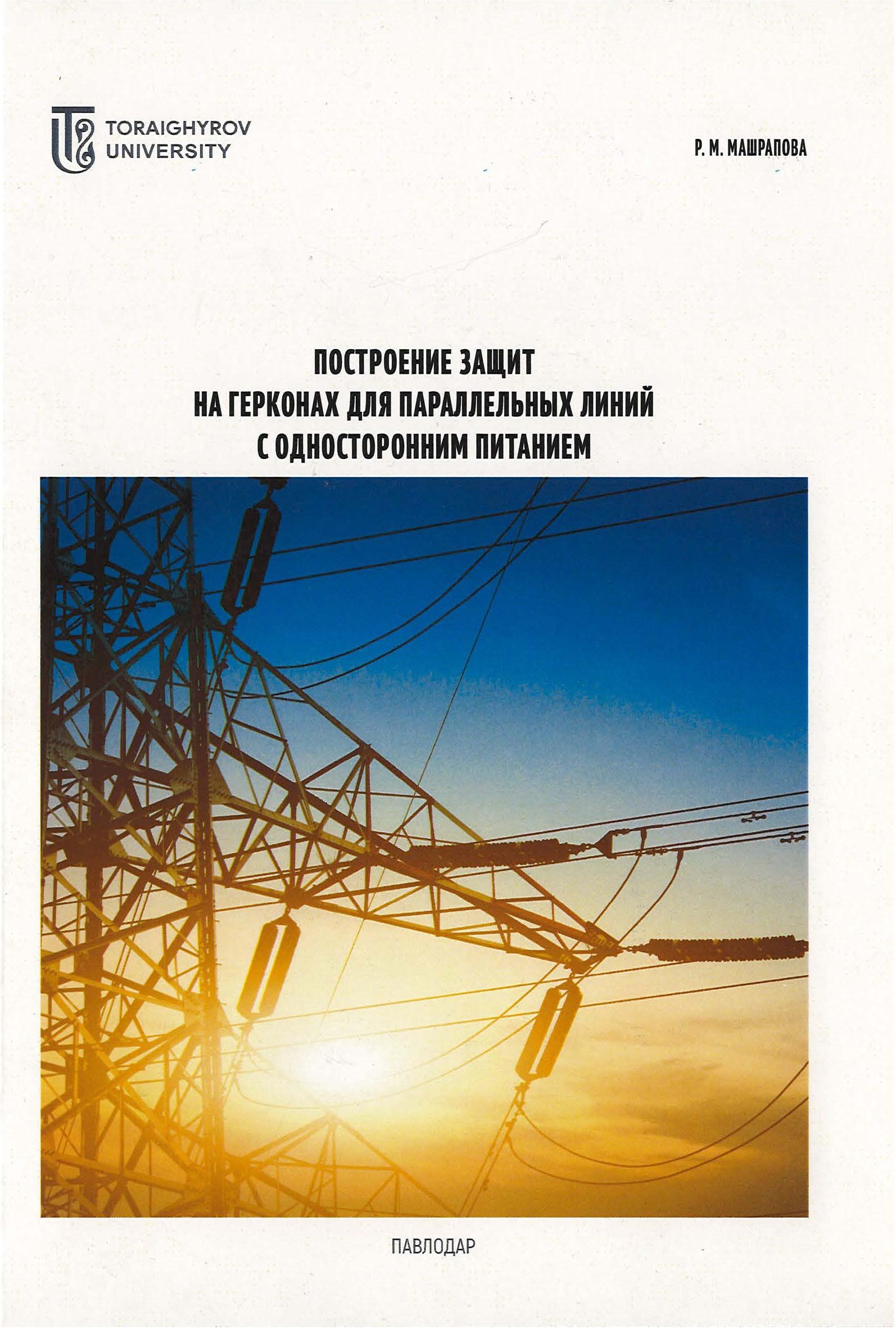
Monograph title: CONSTRUCTION OF REED-SWITCH-BASED PROTECTION FOR PARALLEL LINES WITH ONE-SIDED POWER SUPPLY
Author: Rizagul Megdaniyatovna Mashrapova
ISBN 978-601-345-632-4
Brief Description: This monograph presents the results of research on the development of protection methods for parallel transmission lines using reed-switch devices without current and voltage transformers. It is aimed at creating simple, reliable, and resource-saving relay protection systems applicable on the sending and receiving sides of 6–35 kV parallel lines with a one-sided power supply.
The first chapter reviews well-known transverse protections and their limitations. It is shown that:
1. The conventional transverse directional differential current protection of parallel lines is simple in implementation and does not respond to power swings, yet has several drawbacks, particularly the requirement of information from current and voltage transformers. Existing solutions eliminate all drawbacks except the need for current transformers.
2. Reed switches can be used as current sensors in protection schemes because they offer several important advantages for relay protection.
3. The known transverse differential protection based on reed switches can be applied only on the sending side, may malfunction under transient disturbances, and depending on design, may either trip an unaffected line during double earth faults or fail to operate under cascading line shutdowns. The operating principle does not allow eliminating most of these drawbacks.
4. No receiving-side protection methods for parallel lines without current and voltage transformers have been developed.
The second chapter describes a protection method for the sending side based on monitoring the sequence in which instantaneous currents of identical phases in parallel lines reach a set threshold. The operating condition is formulated using Boolean algebra. Reed-switch-based implementations are presented for two, three, and four parallel lines using semiconductor and electromechanical components, as well as structural diagrams of microprocessor-based algorithms. A method is presented for calculating trip settings and sensitivity taking into account conductor configuration and magnetic fields of both lines. It is shown that the developed protection is immune to short electromagnetic disturbances and ensures correct operation in all line conditions.
The third chapter is devoted to protection schemes for the receiving side. Two approaches are proposed: the first monitors the presence of current equal to or above a specified level after a given time delay from its previous half-wave peak; the second monitors the time interval between successive instants of instantaneous current reaching a threshold in adjacent positive (or negative) half-waves. For each method, Boolean tripping conditions, reed-switch circuits, and operating algorithms are provided for two and three parallel lines.
A solution for ensuring polarity-dependent reed-switch operation is proposed, based on introducing an additional magnetic flux acting on a second reed switch and blocking the output of the first in one half-wave. This increases the sensitivity of receiving-side protection. A calculation method is developed that accounts for mutual influence between reed switches with control windings installed near the same phase, and an equation is proposed for the cascade-operation zone.
Equations are provided for evaluating the applicability of protection methods depending on short-circuit and load current parameters. It is established that receiving-side protection may be applied in 35 kV networks when the minimum load current amplitude exceeds 60 A, and in 10 kV networks when it exceeds 30 A. For sending-side reed switches, the optimal parameters include an operating time of 0.3 ms and a spread of actuation magnetic induction not exceeding 6%.
The proposed protection methods and devices eliminate the need for measuring transformers, reducing the metal content, weight, and size of protection systems. The obtained results can be used to develop protection devices based on electromechanical, semiconductor, and microprocessor platforms.
This monograph is intended for PhD students, Master’s students, and professionals in relay protection and automation, as well as practicing engineers engaged in the design and modernization of protection systems for 6–35 kV transmission lines.
Contents:
|
|
Introduction |
3 |
|
|
1 |
Analysis of Known Transverse Protection Schemes for Parallel Transmission Lines Against Short Circuits |
4 |
|
|
1.1 |
Traditional Directional Current Transverse Differential Protection of Two Parallel Transmission Lines |
4 |
|
|
1.2 |
Protection Schemes for Parallel Transmission Lines with Increased Sensitivity that Use Voltage Circuits |
10 |
|
|
1.3 |
Protection Schemes for Parallel Transmission Lines that Do Not Require Voltage Circuits and Have Increased Sensitivity |
20 |
|
|
1.4 |
Protection Schemes for Parallel Transmission Lines Without Current and Voltage Transformers |
34 |
|
|
|
Conclusions |
42 |
|
|
2 |
A Protection Method for Parallel Transmission Lines from the Sending Side and Devices Based on It Without Current Transformers |
44 |
|
|
2.1 |
A Protection Method for Parallel Transmission Lines from the Sending Side |
44 |
|
|
2.2 |
Reed-Switch-Based Protection for Parallel Transmission Lines |
51 |
|
|
2.3 |
Methodology for Selecting Settings of Reed-Switch-Based Protection |
63 |
|
|
|
Conclusions |
73 |
|
|
3 |
Protection methods and devices based on them without using current transformers for parallel transmission lines from the receiving side |
75 |
|
|
3.1 |
Protection Methods for Parallel Transmission Lines from the Receiving Side |
75 |
|
|
3.2 |
Protection for Two and Three Parallel Transmission Lines Implemented on Polarized Reed Switches |
84 |
|
|
3.3 |
Selection of Operating Parameters of the Proposed Protection |
92 |
|
|
|
Conclusions |
99 |
|
|
|
References |
101 |
|
|
|
Appendix A |
Algorithm of the Logical Part of Protection from the Sending Side |
108 |
|
|
Appendix B |
Example of Calculation of the Operating Settings for Two Parallel Transmission Lines from the Sending Side |
111 |
|
|
Appendix C |
Protection of Three Parallel Transmission Lines from the Receiving Side |
114 |
|
|
Appendix D |
Example of Calculation of the Operating Settings for Two Parallel Transmission Lines from the Receiving Side |
116 |
The full text of the monograph is available at the Beisembayev Library ("Toraighyrov University" NJSC Library), 64 Lomov Street, Pavlodar, Kazakhstan.
For purchase inquiries, please contact the Toraighyrov University Publishing House.
Contacts:
Phone: +7 (7182) 67-36-69 (ext. 1147)
E-mail: kereku@tou.edu.kz